Health and Safety Policy — Commercial Waste Removal Wallington
 This Health and Safety Policy describes the approach adopted by our commercial waste removal operation to manage risks associated with waste and rubbish services across our service area. It sets out responsibilities, safe working practices and the standards that apply to all staff, contractors and partners engaged in commercial rubbish removal in Wallington and nearby locations. The policy sits alongside operational procedures and aims to ensure that every task is planned, supervised and executed with safety as the priority.
Our objectives are clear: to prevent injury, protect public health and minimise environmental harm while delivering a prompt waste removal service. We commit to compliance with relevant statutory requirements and to continuous improvement through regular monitoring and training. All managers and operatives are required to understand and apply these principles when providing commercial waste collection and clearance services.
Scope and Application
This policy applies to all activities connected with the collection, handling, transportation and disposal of commercial and industrial refuse and recycling. It covers routine collections, skip removals, bulky waste clearances and any specialist removals that our team undertakes. The policy also addresses interactions with client sites, on‑site segregation, contamination control and safe vehicle loading and unloading practices.Responsibilities
Senior management holds ultimate responsibility for health and safety policy implementation, ensuring adequate resources and competent personnel. Supervisors must plan daily operations, conduct site-specific risk assessments and confirm that operatives have the information and equipment necessary to perform tasks safely. Individual employees are expected to follow instructions, use provided personal protective equipment and report hazards or near misses promptly.Key responsibilities include keeping written risk assessments current, ensuring vehicle maintenance schedules are observed, and confirming that hazardous items identified during the service are segregated for specialist handling. Training records will be maintained and reviewed to ensure competence for manual handling, use of lifting aids and safe operation of compactors or balers.
 Emphasis is placed on communication: pre-job briefings, toolbox talks and clear handover notes reduce the likelihood of errors. Supervisors are required to document briefings and confirm that all team members understand control measures for slips, trips, falls and contact with sharp objects or hazardous substances encountered during rubbish collection duties.
Risk assessment is central to our safety approach. Assessments identify hazards at client premises and in transit, evaluate the likelihood and severity of harm and define controls. Controls follow the hierarchy of elimination, substitution, engineering, administrative measures and PPE. Where full elimination of a hazard is not possible, strong administrative controls such as exclusion zones and spotters are used to reduce exposure.
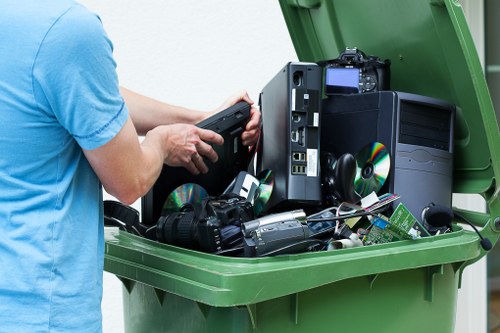
We maintain a clear list of high-risk materials that must not be accepted with general commercial waste. These include certain chemicals, asbestos-containing materials and live electrical equipment. In cases where such items are found, operatives will stop work and follow the safe isolation and reporting protocol as specified in the operational manual.
Safe Systems and Work Practices
Standard safe working practices include correct lifting techniques, team lifts for bulky items, use of mechanical aids and securing loads to prevent movement during transit. Vehicles are fitted with appropriate signage, reversing alarms and securement equipment. Night-time operations follow enhanced lighting and reflective clothing requirements to protect staff and members of the public. Incident reporting and investigation are essential to prevent recurrence. All accidents, near misses and dangerous occurrences must be reported immediately and investigated to identify root causes. Findings lead to amendments in training, procedures or equipment. Records of incidents are retained and reviewed in monthly safety meetings to identify trends and improvement opportunities.
Training and competence are maintained through induction programmes, periodic refresher courses and practical assessments. Training covers manual handling, hazardous waste awareness, vehicle safety, traffic management and spill response. Supervisors are trained to assess competence before permitting operatives to work unsupervised on complex commercial clearances.
Monitoring and review: The policy is reviewed at least annually and after significant incidents or changes to operations. Performance is monitored through audits, route inspections and client site checks. Continuous feedback from the workforce drives improvement in both safety and service delivery for commercial waste services in the area.
- Health and safety goals: zero preventable injuries, legal compliance, minimal environmental impact
- Key controls: risk assessments, PPE, training, safe lifting, vehicle maintenance
- Operational rules: do not accept prohibited hazardous items, secure loads, report issues immediately
All partners and subcontractors engaged for commercial waste removal tasks are required to demonstrate equivalent standards of safety management and to adhere to this policy while working under our control. Through consistent application of these measures, we provide a reliable, safe and professional rubbish removal service across our operational area, safeguarding employees, clients and the public.